Given a choice between ending selfishness and ending stupidity, I always used to prefer and sometimes brashly spoke for ending stupidity. In my arrogance, I considered intelligence the master of reflex and emotion: a proper amount of reflection should lead anyone to adjust their grabbing and self gratifying ways toward the more sustainable relationship with friends and fellow citizens. Thought alone is one tool available to poorest human, I reasoned. The benefits of a yielding consideration of others seemed to me almost as evident as the shorter term benefit of taking for number one whatever was not nailed down and a little meditation would pull you over to the benign.
Now I see selfishness more often as betraying fear: it is the constant practice and the general response of those who think, or more accurately: feel, they won't have enough to get by sooner or later. And while there is a bit of theory to the effect that we may have inborn inclinations toward or away from altruism that vary from person to person, I know it is experience, especially in childhood, that determines our expectations of want. Those experiences are compounded later in life by acquisition of goods and power: having "something to lose" often exacerbates the hostility toward the welfare of others when the sense of insecurity is falsely equated to possessions. And they are determined in ways that won't be changed, not even by a life of wealth and surplus. Surplus, in fact, is rarely defined in our society as having more than the minimum you need to get by, a minimum most of us above poverty cannot and do not want to reckon.
Working counter to that dynamic is the instilled sense of security or adequacy. And that sense can be as irrationally disconnected from one's finances and physical jeopardy as can its opposite fears. And it can be as unacknowledged even as it determines daily choices. That sense that one need not be overly worried about how they will fare next year may come from a constructive childhood where one was guided to experience their own adequacies or from a belief in a deity who watches out for us and imbues us with confidence and hope when we muster faith. Generosity is not so much a matter of having the material wherewithal to give.
I also used to believe that of those two choices, stupidity was more realistically vulnerable to education and exercise of the mind whereas "curing" selfishness seemed to require some unattainable magic. I do not feel so sure of these things now.
Adam Smith viewed the rules of commerce and the freedom to set prices and sell to the highest bidder as "the invisible hand", a benign and almost divine force inherent in the simple rules of the market. To this day, hundreds of years later, many hold with that incomplete vision and think it is all that is needed to account for the increase of wealth since the idea was set to paper. I say "incomplete" because we logged and mined and burnt the world to reach our present state of abundance. Do you deny that it is at best pockets of abundance amid fields of want...and getting more lopsided by the year? Smith was quite right in one thing: The simplest rules and the particular definition of fairness ["honesty in commerce", perhaps?] are all it takes to structure a social order in an economy. I look upon the divisions of wealth and their sick trend and upon the catastrophic one-sided way we share nothing with the earth that has so long given us whatever we wanted and I am certain the invisible hand is the right hand. It is time to change the rules so that the invisible hand is the left hand. Our present state of degradation and poverty in the shadow of towering wealth is not accidental or temporary. And unfortunately because selfishness is the prevailing spirit of the rules that structure humanity's dealings with itself, intelligence is the subservient trait, applied to devising efficiencies that benefit the well to do far more often than those who couldn't or didn't grab a bigger share for themselves.
I have no solution. The choice is a rhetorical device and actual accomplishment of either improvement seems to require magic. There is no magic.
Showing posts with label greensmile living. Show all posts
Showing posts with label greensmile living. Show all posts
Monday, October 15, 2007
Sunday, June 24, 2007
I did hot wire it
I said I would not install and remove circuits in a live 200 amp breaker panel and I reasoned, at the prospect, along the lines of an old post in which I observed my own long journey into caution. But when I opened the breaker panel and looked at each step to be taken and the armamentarium of tools I possess it didn't seem so daunting.
maybe the over caution of a conservative attitude is not so much learned reflex or misfired cognitive development but a matter of what you do on autopilot and assumption vs what you do with your eyes open, with a simple consciousness of what is present before you rather than its history, its associations and your habits having the lions share of your thought.
I should face the fact that my handyman-foo and my hot water heater drama is the stuff of a haircut blog, but if I were that honest about the cosmic significance I try to milk out of my mundane doings there would be no blog at all. You may want to pass by the rest of this post as it really isn't anything more than you would see in five minutes of This Old House...during a writers strike.
The new heaters were set on a proper level slab of blue stone and plumbed as a subsystem. That allows pressure testing before turning off the old heater. The extra valving serves several purposes:

My plumber's nightmare turns out to be Home Depot's wet dream

The worst part of wiring a live breaker panel is how stiff, 8-gauge wire has a mind of its own. The rest is good tools, common sense and lots of practice. The 50-amp breaker was putting the children of the power company's shareholders through college. Its gone. The orange wire is the first of the new circuits wired to the 30 am breaker with the more tractable 10-gauge.
The wiring did not leak. So I cut the dying behemoth out of the system and sweated the final two joints that put the new heaters to work. The old heater was so tall it had to be tilted to get it to clear the floor.
So the bottom line is that we will save money now, go a little easier on the planet and, when penny pinching comes to shove, be able to alter usage to yet greener means.
maybe the over caution of a conservative attitude is not so much learned reflex or misfired cognitive development but a matter of what you do on autopilot and assumption vs what you do with your eyes open, with a simple consciousness of what is present before you rather than its history, its associations and your habits having the lions share of your thought.
I should face the fact that my handyman-foo and my hot water heater drama is the stuff of a haircut blog, but if I were that honest about the cosmic significance I try to milk out of my mundane doings there would be no blog at all. You may want to pass by the rest of this post as it really isn't anything more than you would see in five minutes of This Old House...during a writers strike.
The new heaters were set on a proper level slab of blue stone and plumbed as a subsystem. That allows pressure testing before turning off the old heater. The extra valving serves several purposes:
- cutting back to a single 30 amp heater when its just the two of us here. Either unit can be isolated from the house water system and electrical system.
- a bypass arrangement in the cold water supply. This can be used to preheat the cold water via a heat exchanger. Several sources or potential sources are available.
- We have a "hot water bank" coolant loop in our heat pump which we have never hooked up.
- We could exchange heat with the pool which typically is 20 degrees F warmer than our well water.
- And there is 3/4 inch copper pipe plumbed up to the pitch of the roof which is oriented exactly south and pitched a fairly efficient 4-in-5 considering our 42 degrees north latitude. Yes, I new 15cents/kwh electricity was only a matter of time, even 25 years ago. So did your power company and the DOE but screwing you with profitable old technology is preferable to them. Our break-even threshold for solar collector with a 20 year life to preheat domestic hot water is around 13 cents/kwh and we just hit 11 cents.
- provision for draining either hot water or cold water side of the system independently
- from my software engineering, I know to always design for testability.

My plumber's nightmare turns out to be Home Depot's wet dream

The worst part of wiring a live breaker panel is how stiff, 8-gauge wire has a mind of its own. The rest is good tools, common sense and lots of practice. The 50-amp breaker was putting the children of the power company's shareholders through college. Its gone. The orange wire is the first of the new circuits wired to the 30 am breaker with the more tractable 10-gauge.

The wiring did not leak. So I cut the dying behemoth out of the system and sweated the final two joints that put the new heaters to work. The old heater was so tall it had to be tilted to get it to clear the floor.

So the bottom line is that we will save money now, go a little easier on the planet and, when penny pinching comes to shove, be able to alter usage to yet greener means.
Tuesday, May 29, 2007
Death watch for a hot water heater.
I once posted about the curious way in which a complaint can also be a boast. Its almost like we just can't stand simple and unlayered emotional observation but operate under an urge to spin advantage from all manner of adversity...it is our nature. You may want to turn away if immodesty does not fascinate you for this is definitely going to be a boastful complaint.
I blew off blogging yesterday and barely ventured out into the beautiful spring weather on a day reserved for idleness, barbecue and somber reflection on the human price of war, regardless what was gained for that price. I had, not better things to do, but things I had better do....

Our hot water heater has terminal corrosion. It is days older than its warranty. It had to be located as an obstruction to the hatchway to the crawlspace because it is too tall to fit elsewhere. Rot and dankness result from its increasing leakage. It is surrounded by 25 years worth of "stuff" every item of which was for a moment considered too good to toss and now merely adds its moldy weight to the musty entropy of things that must be sorted, hoisted and disposed prior to the real work.

Replacement by a pair of heaters is planned. Hand truck is adequate to move them horizontally. Vertical is another story...no stairs, ramp, or bulkhead since this house was let into a pocket in the bedrock. The vertical movement of heavy objects, when merely walking about the crawlspace induces injuries, has been a show-stopper. For instance, the carcass of the previous hot water heater has rested down there over ten years, shoved aside because no team of lifters and no rigging was available to extract it from that pit.

And the wiring will be thrill. I have to open up the main service panel to add a 220V breaker and the 10/3NM grounded cable, disconnects and junction boxes for the second heater. I used to hot wire those panels but this time around, I'm throwing the mains and working by flashlight. The older I get, the more vulnerabilities I know of and take to heart.

To solve the vertical challenge, I fashioned a gantry crane. Running along a beam suspended on threaded rods a tram on a phalanx of casters will traverse the load horizontally.

A block and tackle will move the load vertically. That looks like a rats nest but it is a chain stitch and will neatly undo itself with one deft tug.

A test load of 250 pounds of broken rock and dirt [from the Precambrian era of my mess-making...I had to get down to sound weight bearing strata] moved smoothly without a creak or a slip.

Out with the old

And in with the new.
To be continued...
I blew off blogging yesterday and barely ventured out into the beautiful spring weather on a day reserved for idleness, barbecue and somber reflection on the human price of war, regardless what was gained for that price. I had, not better things to do, but things I had better do....

Our hot water heater has terminal corrosion. It is days older than its warranty. It had to be located as an obstruction to the hatchway to the crawlspace because it is too tall to fit elsewhere. Rot and dankness result from its increasing leakage. It is surrounded by 25 years worth of "stuff" every item of which was for a moment considered too good to toss and now merely adds its moldy weight to the musty entropy of things that must be sorted, hoisted and disposed prior to the real work.

Replacement by a pair of heaters is planned. Hand truck is adequate to move them horizontally. Vertical is another story...no stairs, ramp, or bulkhead since this house was let into a pocket in the bedrock. The vertical movement of heavy objects, when merely walking about the crawlspace induces injuries, has been a show-stopper. For instance, the carcass of the previous hot water heater has rested down there over ten years, shoved aside because no team of lifters and no rigging was available to extract it from that pit.

And the wiring will be thrill. I have to open up the main service panel to add a 220V breaker and the 10/3NM grounded cable, disconnects and junction boxes for the second heater. I used to hot wire those panels but this time around, I'm throwing the mains and working by flashlight. The older I get, the more vulnerabilities I know of and take to heart.

To solve the vertical challenge, I fashioned a gantry crane. Running along a beam suspended on threaded rods a tram on a phalanx of casters will traverse the load horizontally.

A block and tackle will move the load vertically. That looks like a rats nest but it is a chain stitch and will neatly undo itself with one deft tug.

A test load of 250 pounds of broken rock and dirt [from the Precambrian era of my mess-making...I had to get down to sound weight bearing strata] moved smoothly without a creak or a slip.

Out with the old

And in with the new.
To be continued...
Monday, May 07, 2007
Life and death in Kansas

The pictures from Greensburg, KS look more like Nagasaki than anything I have ever seen of US disaster photography.

That story was pushed off the front page this morning by the carnage in Iraq and the folly in Washington.
Like Fallwell or Robertson pointing to New Orleans and saying god is mad at us for tolerating gay lifestyle, I will point to poor Greensburg KS and remind you that more frequent and more energetic cyclonic weather is a given when we cause the atmosphere to retain more heat energy. If I speak of a sky god who is angry that we dump methane into the sky, will you understand? If I compare the evil of our incessant polluting to the devils these fundies denounce, will you understand? The people in Greensburg seem a decent and, for farm town Kansas typically religious lot. They will ask, (it is hard not to,) "What did we do to deserve this?"
Nothing.
Or rather nothing more than their tiny share in the increase of atmospheric carbon dioxide and methane, which is 23 times as effective at reflecting escaping heat back toward earth as CO2. Methane only lasts a few years in the atmosphere before breaking down to CO2 and, away from livestock, swamps and certain industries, is at much lower concentrations than CO2. More like the inundation of New Orleans and unlike the Indonesian tsunami or the deadly Kashmir earthquake two years ago, the need to find causes and fix blame is not entirely in vain here. Greensburg is surrounded by feedlots. [see map toward end of pdf "rattlesnake watershed boundary"]. Those sources of methane are just one tiny part of the problem of greenhouse gases but an ignored part. The lack of alarm about global warming and the tendency to stick with poor but personally profitable practices because there is no one huge polluter to blame is a huge problem. Kansas does know feedlots contribute to water pollution. As measured by miles of dirtied rivers, feedlots are the worst polluters of moving water in the state:
sourcesmiles of polluted waterway industrial point sources 927 municipal point sources 3608 combined sewer overflow 152 nonirrigated crop production 14851 irrigated crop production 9280 feedlots 17241 urban runoff 2683 surface mining 522 petroleum activities 5953 septic tanks 104 channelization 313 flow regulation/modification 0 removal of riparian vegetation 11879 streambank modification 0 natural 12598 source unknown 8865
Only three, much more populous, states have bigger feedlot industries. The last thing this post is meant to do is kick some people that are already down. Raising grain and feeding it to animals is one of the main ways, with or without subsidies, that Kansans have ever made a living. It is our preference for steaks burgers and pork chops that makes the feedlot such a an important part of the KS economy, bringing in over 600 million/year revenue. Their soybean crop has has increased and their feedlot business has been off just a bit in the last few years. That is a wholesome trend for consumers that keeps Kansans on the farm. Better switch to veggie burgers. The people in Greensburg feed you, let them feed you something that is good for all of us.
You can send money to the red cross if you don't live close enough to lend an empty bedroom or donate some furniture. Not all counted yet but 10 deaths out of such devastation seems miraculous. That sad but relatively benign statistic shows the power of having enough warning and the technology, the network of radars, barometers and signalling to sound the sirens 20 minutes before the monster tornado came through. Getting the now homeless towns people into real homes would be ideal: their basements saved them but that was not that last tornado Kansas will see and trailer houses have no basement.
You could buy a quilt to have a souvenir for the good you have done. Last year Greensburg chipped in a few quilts of its own but that may be hard to repeat this year.
UPDATE: This is what I am talking about: read editorial memo at the top of the page.
Thursday, May 03, 2007
I give up, I am too steamed to go cold turkey.
Beck must be CNN's clueless and desperate attempt to grab from Rush some of the too-dumb-to-change-the-channel demographic. Seriously, who sponsors an aggressively stupid global warming denialist? Who benefits from being unaware of significant climate change? New York Times notes today how well tropical plants have been growing in formerly subtropical climates. Wherever you live, in the continental US, your growing season [or your air conditioning season] has grown a week or two longer in just 16 years. The guy must be too dumb to read pictures:


Sure, the libruls could have secretly written over the scales on all the thermometers but how did we get the eucalyptus to join our little conspiracy?
Before

After

Sure, the libruls could have secretly written over the scales on all the thermometers but how did we get the eucalyptus to join our little conspiracy?
Monday, April 30, 2007
Who is responsible for Global Warming?
The idea of "carbon offsets" irks me. The idea that creating a market in pollution allowances will have much impact on pollution is a snow job and an escape hatch for industries and consumers who just don't want to do their share. We have had the money to buy oil and burn coal. Now, to repair that, we are going to, (guess what!), yep, buy the oil and the coal and the "credits" invented out of thin air and assigned to someone who pollutes less than we do? In spirit, it appeals to me about as much as the idea that some poor schnook has volunteered to be my carbon whipping boy. Saving the world from overheating is first and foremost a battle to reduce consumption and the fair way to do that would be for every consumer to reduce their consumption.
Its just too simple to do: Less oil burned would be more greenhouse gas reduction. Period. "I can afford not to suffer, I can pay to spare myself any inconvenience." is the simple retort but it is not voiced at an honest volume, not while there are shell games for greenhouse gasses.
The New York Times takes a quick survey of experts on the legitimacy of claimed benefits for the environment and all but calls the whole carbon offsets market a sham. The best quote in the article hits at the heart of why we are stalling: human inertia and the pathetic habit of confusing what you have with what you are.
Its just too simple to do: Less oil burned would be more greenhouse gas reduction. Period. "I can afford not to suffer, I can pay to spare myself any inconvenience." is the simple retort but it is not voiced at an honest volume, not while there are shell games for greenhouse gasses.
The New York Times takes a quick survey of experts on the legitimacy of claimed benefits for the environment and all but calls the whole carbon offsets market a sham. The best quote in the article hits at the heart of why we are stalling: human inertia and the pathetic habit of confusing what you have with what you are.
Michael R. Solomon, the author of “Consumer Behavior: Buying, Having and Being” and a professor at Auburn University, said he was not surprised by the allure of the carbon-offsetting market.There is not much beside curmudgeonhood that I have in common with Boston Globe Columnist, Alex Beam but when he rails against transferring to others the onus of any task or responsibility we ought to share just because we can afford to, I sympathize. Any solution Milton Friedman would approve of warrants severe scrutiny for its effects on the weakest players in the market, especially when the weakest of those players is actually the weather. The weather will hurt the poorest of us the worst. The people who put the most money in their pocket as a consequence of enabling us all to dirty the skies should not be allowed to buy their way out of the mess using the money we have made...that is potentially a runaway positive feedback of power. Until pollution credits are mandatory and costly enough to be punitive they are a smokescreen for business as usual.
“Consumers are always going to gravitate toward a more parsimonious solution that requires less behavioral change,” he said. “We know that new products or ideas are more likely to be adopted if they don’t require us to alter our routines very much.”
But he said there was danger ahead, “if we become trained to substitute dollars for deeds — kind of an ‘I gave at the office’ prescription for the environment.”
Sunday, April 29, 2007
how to heat your house without heating your planet
The Insufferable Carbon Snob went green on domestic heating decades ago...way back when Jimmy Carter and OPEC in their very different ways, stressed the importance of using less oil.
Greensmile has given you an earful of the financial and moral dimensions to heedless consumption of fossil fuels...plenty of fodder for future posts. But ICS wants you to think about the money today. Abandoning fuelish ways by switching to housing that is better insulated and uses carbon neutral heat sources is only expensive in the short term. Here is one family's response to global warming and peak oil.
You may find moralizing on sustainability issues tedious. Too obvious, too self-righteous, so much easier to say than to do...etc. Stow it. I have not yet begun to preach. I may slip into a hortatory tone out of habit now and then but pay it no mind. Today, just keep an eye on your checkbook. Here is one way to keep heating costs down and net carbon emissions low as well.
It took us 17 years to pay off all the mortgages. It would have been longer if the "conventional" heat sources had been used.
Building inspectors are conservative in my experience but the really dangerous discouragement comes from the lenders. They demand a conventional heat source to insure the sale of your house should you fail to make payments. If you take out a construction loan for the building phase, lenders dole the money out according to a fixed sequence of completion steps that may not match the increments of expenditure for a solar heated house...you make up the difference.
To make any design work, you must do a heat budget. Being handy with software, I wrote a program that could estimate the heat lost by various designs and various choices of construction materials. It is essentially a software model of a house based on the blueprints. This allows you to know how big a heat source you will need. My numbers were in the range of 30000 BTU/hr in worst winter conditions. That means a 50000 BTU/hr wood stove will suffice.
Most tables that give a way to compare your heating options only apply to conventional construction so you will have to find one that accounts for the amount of insulation you want to put into your house. The table linked is from a Canadian source and would be appropriate for conventional housing stock, not applicable to super insulated nor to solar heating. Many of the books on designing solar heated houses that I bought were written right after the "oil shock" of 1973. Since then we went back to driving trucks to get our lattes and many of those books never saw a second edition. There are a few attractive new books reviewed at this site but the one with the best table of contents is unknown to Amazon. This book claims to have the software for figuring out if your design will work for solar heating your house but I have not read it. To name one book that I like [it has worked examples for our part of the country]: The Solar Home Book by Bruce Anderson, of which no revisions were made since 1976. The core piece of the design task is to add up the contribution to heat loading for each square foot of your house's surface based on the R-value of the walls, windows, roof etc. and figure out how much sun will come through the windows. Vertical glazing is the simplest and works better than sloped because you don't swelter in the summer. The design we have works at its best when the weather is at its coldest with snow on the deck reflecting additional heat into the house:
The romance goes out of wood heat pretty quickly. Its dirty and it always snows when you need to go out to the woodpile for another load. Its far more work and far better exercise than turning up a thermostat. So I never bought a membership at a gym. It is only when there have been two cloudy days back to back that there is any need for the stove. Here in grinding detail are formulas to compute heating costs for wood and comparisons to oil and electric heat. But the important thing is not how you heat but how much heat you keep. Before you do any other thing to reduce oil consumption, insulate your house well. With R-30 walls and an R-40 roof, just the sun alone warms the air over the pool strongly. We simply open windows between the solarium and the living quarters to let a convection current do what blowers, furnaces and duct work do in our neighbors houses. The picture below shows a pink postit suspended by a thread from the yellow thumbtack wafting in the warm current of air. That crude tell-tale is all the technology we use to control when to open or close "for solar". It is of course an utterly silent means of heating.
The bottom line for us is about $500/yr in delivered cord wood heats our 4000sq ft house where our neighbors are paying about 2000 to $2400 per season for oil depending on how big their house is. The performance of course depends on the sun but it is generally quite gratifying. Our coldest weather is dry and windy and often sunny. Winter days when it is below freezing outside and we wake to a 65 degree house, light no fire and go to bed in a 75 degree house feel like a perpetual bonus.
The carbon we put back in the air came out of the air. In that sense, wood burning is carbon neutral if you don't truck the wood from far away. I get it when building lots are being cleared in my neighborhood and split it by hand so fuel burnt to fetch fuel is at an absolute minimum. We recycle the ashes as a fertilizer ingredient in our compost and as ice-melt on the driveway.
If you own, getting insulation is money well spent. If you can remodel to put larger well insulated windows on the sunny side of your house, it can pay you back nicely. If you are smart or lucky enough to be building now that the deflating housing market has made good carpenters available, you should just say "screw resale value" and build yourself a house you will actually enjoy and feel good about.
If you just talk about global warming and blame everything on Detroit, Exxon and Bush, STFU. Demand better choices and make better choices.
Greensmile has given you an earful of the financial and moral dimensions to heedless consumption of fossil fuels...plenty of fodder for future posts. But ICS wants you to think about the money today. Abandoning fuelish ways by switching to housing that is better insulated and uses carbon neutral heat sources is only expensive in the short term. Here is one family's response to global warming and peak oil.
If you can't afford to do the right things about energy use, you are in the wrong place.
So quit making excuses 'cause YOUR world is broken and you CAN fix it. To put this haughty bit of moralizing in the economic framework some of you might respond to: If you can't afford to do the right things about energy use now, what makes you think it is going to get easier to afford to shift to greener ways later on? You are adrift and headed for the falls. Unless the energy companies that sponsor the present US administration can be convinced that it is in their interest to do something beside move armies and earth to bring you yet more oil and coal to burn, it will be entirely up to us fat-assed consumers to make the changes.You may find moralizing on sustainability issues tedious. Too obvious, too self-righteous, so much easier to say than to do...etc. Stow it. I have not yet begun to preach. I may slip into a hortatory tone out of habit now and then but pay it no mind. Today, just keep an eye on your checkbook. Here is one way to keep heating costs down and net carbon emissions low as well.
It took us 17 years to pay off all the mortgages. It would have been longer if the "conventional" heat sources had been used.
Building inspectors are conservative in my experience but the really dangerous discouragement comes from the lenders. They demand a conventional heat source to insure the sale of your house should you fail to make payments. If you take out a construction loan for the building phase, lenders dole the money out according to a fixed sequence of completion steps that may not match the increments of expenditure for a solar heated house...you make up the difference.
About 25 years ago we were ready for a bigger house and could not find a contemporary we liked. We decided to build. The plans began with the idea that we should be able to get most of our heat from the sun. The first thing you do then is site the house with most of its glass facing south and with the greatest thermal mass you can accommodate. Water is superior for this purpose, having a higher specific heat than any common building material. All the better if you can swim in your heat sink once in a while: Facing due west, a view of the glass wall and 50,000 gallons of thermal mass.
 Facing due west, a view of the glass wall and 50,000 gallons of thermal mass.
To make any design work, you must do a heat budget. Being handy with software, I wrote a program that could estimate the heat lost by various designs and various choices of construction materials. It is essentially a software model of a house based on the blueprints. This allows you to know how big a heat source you will need. My numbers were in the range of 30000 BTU/hr in worst winter conditions. That means a 50000 BTU/hr wood stove will suffice.

Most tables that give a way to compare your heating options only apply to conventional construction so you will have to find one that accounts for the amount of insulation you want to put into your house. The table linked is from a Canadian source and would be appropriate for conventional housing stock, not applicable to super insulated nor to solar heating. Many of the books on designing solar heated houses that I bought were written right after the "oil shock" of 1973. Since then we went back to driving trucks to get our lattes and many of those books never saw a second edition. There are a few attractive new books reviewed at this site but the one with the best table of contents is unknown to Amazon. This book claims to have the software for figuring out if your design will work for solar heating your house but I have not read it. To name one book that I like [it has worked examples for our part of the country]: The Solar Home Book by Bruce Anderson, of which no revisions were made since 1976. The core piece of the design task is to add up the contribution to heat loading for each square foot of your house's surface based on the R-value of the walls, windows, roof etc. and figure out how much sun will come through the windows. Vertical glazing is the simplest and works better than sloped because you don't swelter in the summer. The design we have works at its best when the weather is at its coldest with snow on the deck reflecting additional heat into the house:

The romance goes out of wood heat pretty quickly. Its dirty and it always snows when you need to go out to the woodpile for another load. Its far more work and far better exercise than turning up a thermostat. So I never bought a membership at a gym. It is only when there have been two cloudy days back to back that there is any need for the stove. Here in grinding detail are formulas to compute heating costs for wood and comparisons to oil and electric heat. But the important thing is not how you heat but how much heat you keep. Before you do any other thing to reduce oil consumption, insulate your house well. With R-30 walls and an R-40 roof, just the sun alone warms the air over the pool strongly. We simply open windows between the solarium and the living quarters to let a convection current do what blowers, furnaces and duct work do in our neighbors houses. The picture below shows a pink postit suspended by a thread from the yellow thumbtack wafting in the warm current of air. That crude tell-tale is all the technology we use to control when to open or close "for solar". It is of course an utterly silent means of heating.

The bottom line for us is about $500/yr in delivered cord wood heats our 4000sq ft house where our neighbors are paying about 2000 to $2400 per season for oil depending on how big their house is. The performance of course depends on the sun but it is generally quite gratifying. Our coldest weather is dry and windy and often sunny. Winter days when it is below freezing outside and we wake to a 65 degree house, light no fire and go to bed in a 75 degree house feel like a perpetual bonus.
The carbon we put back in the air came out of the air. In that sense, wood burning is carbon neutral if you don't truck the wood from far away. I get it when building lots are being cleared in my neighborhood and split it by hand so fuel burnt to fetch fuel is at an absolute minimum. We recycle the ashes as a fertilizer ingredient in our compost and as ice-melt on the driveway.

If you own, getting insulation is money well spent. If you can remodel to put larger well insulated windows on the sunny side of your house, it can pay you back nicely. If you are smart or lucky enough to be building now that the deflating housing market has made good carpenters available, you should just say "screw resale value" and build yourself a house you will actually enjoy and feel good about.
If you just talk about global warming and blame everything on Detroit, Exxon and Bush, STFU. Demand better choices and make better choices.
Wednesday, April 25, 2007
In the Spring, an old man's fancy lightly turns...

...to compost.
If Tennyson asks for an apology, I'll give him one.
Like the fly, fallen leaves are among the creator's more dubious achievements. They are mobile dirt. They annoy us with perpetual work of the sort advertisers assure us we are too busy and too noble to do. But all such built in annoyances should be weighed on a scale of wholeness where decay answers growth as two dancers answer each other's every move. It was on that scale that creation worked itself out. Here is a little photo essay the Insufferable Carbon Snob put together to help you get over any silly preference you may have for using garbage disposals. The carbon can circle from garden to table to compost and back for ever. Your little job is just to keep "for ever" on the tracks and moving.
If you live in an apartment, and don't grow any house plants you may be excused. That should not discourage you from gardening at one of the shared gardening sites that many towns offer. At such community gardens, composting is encouraged. I have seen them in Boston and in many of its woodsier suburbs so don't be surprised if you have been missing the opportunity to do something with your leftovers and scraps beside burden the sewage treatment facilities.
If you have a back yard of any size at all and you are not growing things, consider moving in with the folks in the paragraph above. Let someone sequester a little carbon since you are wasting the opportunity.
If you don't discharge your waste water to the town sewage but rather your own septic system, all the more financial incentive to compost. We have the sceptic pumped every 6 years instead of every two and it is in perfect working order.
If you are still with me, the rest is simple. Get a bucket that seals, opens with one finger and holds about a gallon of slop. That provides for a weeks worth of cooking, is easy enough to use that it will get used and it won't stink you out of the kitchen. That is stage one. About once a week you will be going to your compost bin or to an intermediary stage. The picture here is my stage one and a stage two, anaerobic, bucket to which I am dumping the weeks slops. I always stir the bucket when a new batch comes from the kitchen and I don't drain off liquids like coffee or turkey juices...it all adds to the sewagey consistency and keeps out the air.

Anaerobic decomposition is a vile smelling process, more or less like a sceptic system. I use about eight or ten 5-gallon buckets with air tight lids. This lets me put an entire winters worth of slops to work fermenting while my stage three compost bins are frozen solid. These are just reused buckets from when I seal coated my driveway but you can buy such buckets if none are laying around loose behind the local restaurants or paint shops.

Once in the spring and once in the fall, I lug the whole collection of buckets to the real composting operation in the far back corner of the lot. There are two composters here, one that lets rain in.

And one that runs kinda dry.
 Then there is a sequence of operations
- Unload most of the compost from the dry bin and screen it into mortar tubs or a wheel barrow: this is the end product and as good as you'd buy from a gardening store. It does tend to grow volunteer tomatoes at a furious pace but that may not be a bad thing.
- transfer last seasons material from the wet bin to the dry bin leaving a little material as a "starter culture". This is similar to some sourdough baking techniques.
- add about three quarters of the rotten slops to the dry bin and mix thoroughly
- In the wetter bin, a mix of leaves, the rest of the putrid buckets of kitchen waste and some ashes from the wood stove [we will get to heating in a later post]. The ashes balance the low pH of the oak leaves.
I didn't start out with this composting religion. I learned it from my daughter. It is odd how satisfying this "chore" is to me.
Natural history
ETBNC is one of my most thoughtful commenters. Almost a year ago, we exchanged a few comments and in the process, he made me realize that while capital H History [what arrogance!] may not be over, natural history is.
My personal fear, one I apparently share with a growing minority in this nation, is that we may have broken more than we can fix. We seem, for the first time in American History to have a slight PR edge and growing though minor demographic to employ against the flat earth wasters. My own shortcomings with regard to my ecological foot print I will leave to the Insufferable Carbon Snob to confess. There will be a confused and self contradictory series of posts from the ICS...we who have lived well must, of necessity, be more than a little conflicted about living within the means of what would be our share of the planet, were any environmental justice or equality to suddenly break out.
Natural history ends when you have a predator that can just keep switching prey as it wipes out one thing after another. That ability to switch, more or less unprecedented in the history of the world, spells the end of natural history. We take a piece of ground and we don't move on until nothing will grow there and nothing to eat lives there any more.Any natural predator comes into balance with its prey or perishes when it has eaten is food source into extinction. Its a good rule not to break. We broke it.
My personal fear, one I apparently share with a growing minority in this nation, is that we may have broken more than we can fix. We seem, for the first time in American History to have a slight PR edge and growing though minor demographic to employ against the flat earth wasters. My own shortcomings with regard to my ecological foot print I will leave to the Insufferable Carbon Snob to confess. There will be a confused and self contradictory series of posts from the ICS...we who have lived well must, of necessity, be more than a little conflicted about living within the means of what would be our share of the planet, were any environmental justice or equality to suddenly break out.
Monday, April 23, 2007
Not just one day a year
Except a few astronauts, most of you live on this earth 365 days a year.
The alternative to living sustainably is what?
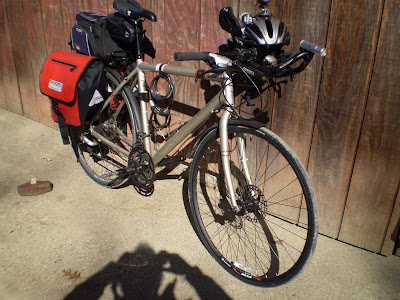 My other car is also a bike.
The alternative to living sustainably is what?
 My other car is also a bike.
Thursday, April 12, 2007
Why isn't the tragedy of the commons a Conservative's cause?
I have never in my life taken one course or read one book on economics. There are copies of Thomas Freidman and Jarred Diamond books somewhere in the "to read" pile. Garrett Hardin's book, I have never seen. No copy of WSJ or IBD on the coffee table either. You will learn nothing from reading what I think about the world economy. I am prompted to talk about the economy because of what I don't hear when economic reportage flickers for a moment on the nightly news or blurry continual lowing of the bulls on the business news channels.
The lag between sustainability warnings sounded decades ago and the token concern for it just now entering political speeches may be fatal. Alarms sounded for distant problems go unheeded and the people have to have widespread economic discomfort which they can clearly connect to unsustainable practices before they will reward these well advised politicians with a bit of attention.
There is for now only one economy. The peak of oil production is also the peak of the parabolic trajectory of our own standard of living. You can't see that connection if you live in denial of peak oil. The regional economies merged into a global economy for a combination of reasons and enabling circumstances. The opportunity seems to depend only on the emergence of political toleration and accommodation between nations: hold your nose and abolish your tariffs. Then cheap labor can be exploited. The irony of Walmart's Bush-voting customers lining up to buy stuff their unemployed neighbors used to manufacture because the last effective communist economy is happy to exploit its workers in return for enough cash to finance the worlds largest "economic boom" is not in enough minds. Walmart has been doing well with this situation too. Isn't it a win-win? [are we really converting the Chinese to capitalism or are we really transferring our wealth to a power that will be happy to hold us in the position of a colony once they hold the reins of world energy as we once did] One of the critical circumstances is that fuel was cheap enough that goods from anywhere could be shipped where ever money would buy them. The other is that only some of the workers are paid well. The invisible hand has become like a giant bulldozer spreading the pile of money in the us all over the globe. When little of the money is left and far more money is needed to move the goods, whatever their cost of production, the economies in extracting resources, manufacturing goods and consumption will have to disengage somewhat. Their current interdependence rests on transportation so they simply are not sustainable. Technological fixes are weak hopes. The logical fix that will eventually be forced upon us is to consume less, and probably to let our population decline.
I warned that I am ignorant of economics so maybe somewhere the arithmetic has been carried out unbeknownst to me. But FAIK, none of the wealth engines that were ascribed to various economies, from the industrial revolution to the post WWII emergence of US economically straddling the world, were fully costed out. If the constant dollar replacement cost of the resources mankind burned through in each of the economic booms were added to the tab, I don't know that we would be far ahead or behind a break-even. We should be thinking of ourselves as carrying a huge debt, a marker for the resources we have withdrawn from our earth, perhaps unreturnably.
Either I don't get it...or most of our leaders don't get it: essentially 0% of America's political "conservatives" voice even the slightest clue that woods, water, air and the unfarmed creatures we eat also need to be conserved. The party of Cheney and Polombo foster not only the imbalance of payments with our trading partners and the wild borrowing that is an imbalance of trade with our own future selves, it is making the US poor via the imbalance of our commerce with the source of all wealth.
Russert interviewed Thomas Friedman last fall about the update to his flat earth book. TF's prediction: "green power" will be to 21st century China what the automomibile was to 20th century US. Gore gets it but if he is not electable, if the voters don't get it because they just can't see any good except the comforts they amass, what then?
Sustainable practices do not become "economic" in the conventional sense of economics until is is too late. The consumer is carefully kept unaware of the depletion their consumption gives rise to. The corporation is governed to consider its wealth at the end of this year the ultimate measure of good. How is this system working out for us?
The wealth of nations may indeed flow wherever the invisible hand of market forces can carry it and wealth is power. Whenever personal wealth is divorced from the national wealth, the state must sooner or later loose the power to spend, which is the only power because no law or foreign policy is enforced for free.
The fate of a nation is hidden in the character of its people: what they will endure, what they will do without. Markets are hoped to be a democracy of dollars. But a market with no money in it is a democracy with no vote. If all you have is money and nothing left to buy, you are profoundly poor.
Market economies are touted by conservatives as creators of wealth. They are only redistributers of wealth. Labor and nature create created the wealth and they are not inexhaustible...and it is they that need conserving.
UPDATE: It turns out a few economists ARE starting to think this way...and they conclude no politician ever will think this way and still stay in office. That is the conventional wisdom: green is political suicide. But not-green is environmental suicide. Why do modern, industrialized lives seem to operate with less sense of connection and responsibility to the future on the part of normal citizens than we romantically think to have been the case for more primitive and primarily agricultural societies? This researcher says we were always wasters of nature. This one says we were not. Except for the findings of our sciences, we consumers are onlybecoming more decoupled from our impacts on nature because the layers of technology and ever more compartmentalized divisions of labor that accompany the technology denature our expectations. We are all so isolated from the organic strata that actually feed us that we can't see why the supermarket shelves might some day be bare. We move about so readily and often as to have lost all sense of connection to the earth under our feet. Do too many of us live in places where it seems the entire world is man-made and so we settle into an illusion of being in complete control? Have we become so oblivious to our personal mortality that we can't think about the days that will dawn without us?
The lag between sustainability warnings sounded decades ago and the token concern for it just now entering political speeches may be fatal. Alarms sounded for distant problems go unheeded and the people have to have widespread economic discomfort which they can clearly connect to unsustainable practices before they will reward these well advised politicians with a bit of attention.
There is for now only one economy. The peak of oil production is also the peak of the parabolic trajectory of our own standard of living. You can't see that connection if you live in denial of peak oil. The regional economies merged into a global economy for a combination of reasons and enabling circumstances. The opportunity seems to depend only on the emergence of political toleration and accommodation between nations: hold your nose and abolish your tariffs. Then cheap labor can be exploited. The irony of Walmart's Bush-voting customers lining up to buy stuff their unemployed neighbors used to manufacture because the last effective communist economy is happy to exploit its workers in return for enough cash to finance the worlds largest "economic boom" is not in enough minds. Walmart has been doing well with this situation too. Isn't it a win-win? [are we really converting the Chinese to capitalism or are we really transferring our wealth to a power that will be happy to hold us in the position of a colony once they hold the reins of world energy as we once did] One of the critical circumstances is that fuel was cheap enough that goods from anywhere could be shipped where ever money would buy them. The other is that only some of the workers are paid well. The invisible hand has become like a giant bulldozer spreading the pile of money in the us all over the globe. When little of the money is left and far more money is needed to move the goods, whatever their cost of production, the economies in extracting resources, manufacturing goods and consumption will have to disengage somewhat. Their current interdependence rests on transportation so they simply are not sustainable. Technological fixes are weak hopes. The logical fix that will eventually be forced upon us is to consume less, and probably to let our population decline.
I warned that I am ignorant of economics so maybe somewhere the arithmetic has been carried out unbeknownst to me. But FAIK, none of the wealth engines that were ascribed to various economies, from the industrial revolution to the post WWII emergence of US economically straddling the world, were fully costed out. If the constant dollar replacement cost of the resources mankind burned through in each of the economic booms were added to the tab, I don't know that we would be far ahead or behind a break-even. We should be thinking of ourselves as carrying a huge debt, a marker for the resources we have withdrawn from our earth, perhaps unreturnably.
Either I don't get it...or most of our leaders don't get it: essentially 0% of America's political "conservatives" voice even the slightest clue that woods, water, air and the unfarmed creatures we eat also need to be conserved. The party of Cheney and Polombo foster not only the imbalance of payments with our trading partners and the wild borrowing that is an imbalance of trade with our own future selves, it is making the US poor via the imbalance of our commerce with the source of all wealth.
Russert interviewed Thomas Friedman last fall about the update to his flat earth book. TF's prediction: "green power" will be to 21st century China what the automomibile was to 20th century US. Gore gets it but if he is not electable, if the voters don't get it because they just can't see any good except the comforts they amass, what then?
Sustainable practices do not become "economic" in the conventional sense of economics until is is too late. The consumer is carefully kept unaware of the depletion their consumption gives rise to. The corporation is governed to consider its wealth at the end of this year the ultimate measure of good. How is this system working out for us?
The wealth of nations may indeed flow wherever the invisible hand of market forces can carry it and wealth is power. Whenever personal wealth is divorced from the national wealth, the state must sooner or later loose the power to spend, which is the only power because no law or foreign policy is enforced for free.
The fate of a nation is hidden in the character of its people: what they will endure, what they will do without. Markets are hoped to be a democracy of dollars. But a market with no money in it is a democracy with no vote. If all you have is money and nothing left to buy, you are profoundly poor.
Market economies are touted by conservatives as creators of wealth. They are only redistributers of wealth. Labor and nature create created the wealth and they are not inexhaustible...and it is they that need conserving.
UPDATE: It turns out a few economists ARE starting to think this way...and they conclude no politician ever will think this way and still stay in office. That is the conventional wisdom: green is political suicide. But not-green is environmental suicide. Why do modern, industrialized lives seem to operate with less sense of connection and responsibility to the future on the part of normal citizens than we romantically think to have been the case for more primitive and primarily agricultural societies? This researcher says we were always wasters of nature. This one says we were not. Except for the findings of our sciences, we consumers are onlybecoming more decoupled from our impacts on nature because the layers of technology and ever more compartmentalized divisions of labor that accompany the technology denature our expectations. We are all so isolated from the organic strata that actually feed us that we can't see why the supermarket shelves might some day be bare. We move about so readily and often as to have lost all sense of connection to the earth under our feet. Do too many of us live in places where it seems the entire world is man-made and so we settle into an illusion of being in complete control? Have we become so oblivious to our personal mortality that we can't think about the days that will dawn without us?
... psychophysical scales are notoriously debatable. An increasing number of researchers would agree that it is highly problematic to postulate a deterministic relationship between measurable environmental factors and occupants’ evaluation of environmental conditions...
Monday, March 26, 2007
Introducing the Insufferable Carbon Snob
One of the animals in the Executioner's split personality menagerie, who has no time but plenty of cause to blog, insists on meeting y'all. Having been smitten by the authoritative style of the Insufferable Music Snob, he wishes to be called the Insufferable Carbon Snob. Take it away ICS...
First, I want to have a word with you sinners about your cellulose. The only unquestionably justifiable cellulose consumption is the fiber in your celery and cereal and such. As for your magazine subscriptions...over that, you should feel a bit guilty. Its hard to get away from the tide of dead trees that comes sluicing at you through your mail box, I know.
 We are taught to cherish paper so the habit is hard to shake.
But I have whittled away at the stream with some success so let me give a few pointers.
On line editions are down loadable to that empty 250 Gbyte hard drive and they are searchable, even the PDFs. I have 30 year old stacks of Scientific American in the basement slowly turning into nests for rodents and I can never find the articles I vaguely remember to be in those stacks.
 The bidet pictured was bought second hand from a plumber and, installation included, cost us less than $500 in 2006 dollars because it went in to new construction, by design. New appliances retrofitted would set you back closer to $2000 and up.
The ICS is down to four hard copy subscriptions, one purposely taken for its value as kindling, the others: Wired, Nutrition Action and Tikkun. Plenty of other stuff does show up unsolicited. As each comes up for renewal, we will elect to take the online versions. I have begged for AAAS to deal with me only in bytes but that Science subscription just seems stuck in reverse at PAPER. Scientific American and Nature, quite graciously switched over. I am burning my collection to CD...heirloom stuff, I tell ya. Wired editorial in this month's edition:
 A paper recycling bin at least as handy as your trash can
 If curbside recycling is not offered in your municipality, schlep it yourself. Use the biggest containers you can manage and better yet use containers that are themselves recycled in the process. [There are neither curbs nor sidewalks in greensmileville.]
First, I want to have a word with you sinners about your cellulose. The only unquestionably justifiable cellulose consumption is the fiber in your celery and cereal and such. As for your magazine subscriptions...over that, you should feel a bit guilty. Its hard to get away from the tide of dead trees that comes sluicing at you through your mail box, I know.
 We are taught to cherish paper so the habit is hard to shake.
 - Get a post office box. That way the spot where you receive junk mail is two paces from the location of a commodious paper recycle bin that someone else must empty.
- Do not become interested in publications that have no on-line presence or edition. Just don't, its not fashionable.
- To wean yourself from the ink-on-paper love affair most of us have indulged since our 1st grade teachers beat the reverence for the printed word into our skulls, buy a gorgeous hi-res flat screen monitor. Locate it where there is no glare.
- Let all your paper subscriptions lapse. Its true that the volume of renewal notices will initially match the tonnage of the periodicals you were taking but trust me: it tapers off after a few years. Subscribe to the online editions of things. After all, you aren't still getting your porn through the US Mail are you?
- Install a bidet [we will be revisiting that T-paperless aspect of green style in a later post]
- Make paper recycling easy for yourself. Have receptacles handy indoors and huge outdoors to avoid the inevitable bouts of inertia that cause you to toss paper in the trash out of laziness or because the bin is overflowing.
- Bring your own reusable cloth shopping bags to the grocery...or any...store. Damp produce that must go in a plastic bag gives you an opportunity to reuse the bag as a trash can liner.
- Your xmas cards could be e-mails, your bar mitzvah, wedding etc. invitations could be evites or your own tasteful PHP/mySQL app if you are handy. No more "we didn't get it, it must have been lost in the mail". You were keeping BOTH address books up to date weren't you? People who won't give you an email addy will just have to phone you once in a while to find out whats going on...drop 'em.
- The best of paper is the worst of paper: unglossy newsprint B&W with soy ink can be used in your wood stove. All that other chemically altered, clay filled crap really is a disposal problem.
On line editions are down loadable to that empty 250 Gbyte hard drive and they are searchable, even the PDFs. I have 30 year old stacks of Scientific American in the basement slowly turning into nests for rodents and I can never find the articles I vaguely remember to be in those stacks.
 The bidet pictured was bought second hand from a plumber and, installation included, cost us less than $500 in 2006 dollars because it went in to new construction, by design. New appliances retrofitted would set you back closer to $2000 and up.
The ICS is down to four hard copy subscriptions, one purposely taken for its value as kindling, the others: Wired, Nutrition Action and Tikkun. Plenty of other stuff does show up unsolicited. As each comes up for renewal, we will elect to take the online versions. I have begged for AAAS to deal with me only in bytes but that Science subscription just seems stuck in reverse at PAPER. Scientific American and Nature, quite graciously switched over. I am burning my collection to CD...heirloom stuff, I tell ya. Wired editorial in this month's edition:
...we discovered the WIRED Uncertainty Principle: Some of you hate uncertainty! We tell you what we don't know, and you answer "God" And then you ask why we left the Big Guy out. We had to. Whether a supreme being exists or not, invoking one to answer a question extinguishes inquiry.How cool is that? I can't let that subscription lapse but I am simply not taking it on dead trees: much more than the carbon in the copy is at stake in decreasing the volume of the paper stream. Now WIRED is a great mag to leave on your coffee table, casually opened to the editorial page. I will just print that one page, in large font to catch the visitor's eye. The ICS has this silly idea that coffee tables really ought to have room for coffee.
 A paper recycling bin at least as handy as your trash can
 If curbside recycling is not offered in your municipality, schlep it yourself. Use the biggest containers you can manage and better yet use containers that are themselves recycled in the process. [There are neither curbs nor sidewalks in greensmileville.]
Saturday, March 03, 2007
While chopping wood.

I spent the afternoon chopping wood. Long thoughts would not coalesce but this thought walked back and forth in my mind:
The more outwardly visible, the more distinguishing the manifestation of mind. The clothes we choose to wear, the fears we support as well founded, the beliefs we attack as mistaken...each of us seems to go a slightly different way in these workings of our thought. In contrast, at our core of simple and singular awareness, obscured and slumbering though it may be, rests the very same thing in each mind, the identical agent in each of our beings. But that commonality is generally missed because few try and fewer succeed in removing or penetrating the debris with which accident and culture burden and entangle the pure observer within. Discipline is needed to reach that spot and then sit still, attending all.
Subscribe to:
Posts (Atom)